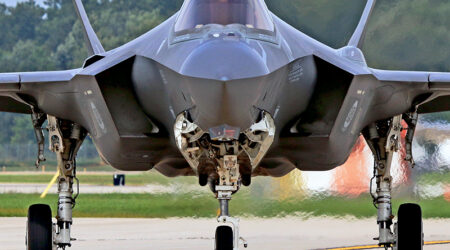
F-22 Raptor - The Air Dominance Fighter
The F-22 Raptor is a fifth-generation fighter aircraft with unmatched air dominance capabilities. It combines stealth, super cruise, supermaneuvrability and advanced avionics capabilities to rule the skies. It is a single seat, twin engine, all weather, night attack, having enhanced radar and avionics with a maximum speed of mach 2 with ability to fly at mach 1.6 without having to use afterburners giving it unmatched combat radius. With air to air refueling capability, it can fly long range missions without having to land for refueling.
History of F-22
The F-22 was developed from Advanced Tactical Fighter program in the US Air Force. The program was initiated to replace the F-15 Eagle and F-16 Fight Falcon aircrafts. Both these aircrafts were superior in terms of performance but were exposed to modern radars, Surface to Air Missiles (SAMs) and other modern ground and air threats. The aim of the program was to develop a new fighter aircraft capable of operating undetected in high threat environments such as modern SAM threats and advanced maneuverable aircrafts such as SU-27 flanker family.
Flight Test phase of ATF program
Two prototypes were developed as part of the ATF program, the YF-22 by Lockheed Martin and YF-23 by Northrop. The flight test program for both prototypes was carried out at the Flight Test Center at Edwards Air Force Base, California. The Edwards AFB is also called the home of flight test home of US Air Force. The flight test program started in 1990. Both the prototypes flew for an year with a total of 124 test sorties as part of the demonstration and validation phase of the the Advanced Tactical Program.
F-22 Raptor Specification
Primary function: air dominance, multi-role fighter
Contractor: Lockheed-Martin, Boeing
Power plant: two Pratt & Whitney F119-PW-100 turbofan engines with afterburners and two-dimensional thrust vectoring nozzles.
Thrust: 35,000-pound class (each engine)
Wingspan: 44 feet, 6 inches (13.6 meters)
Length: 62 feet, 1 inch (18.9 meters)
Height: 16 feet, 8 inches (5.1 meters)
Weight: 43,340 pounds (19,700 kilograms)
Maximum takeoff weight: 83,500 pounds (38,000 kilograms)
Fuel capacity: internal: 18,000 pounds (8,200 kilograms); with 2 external wing fuel tanks: 26,000 pounds (11,900 kilograms)
Payload: same as armament air-to-air or air-to-ground loadouts; with or without two external wing fuel tanks.
Speed: mach two class with supercruise capability
Range: more than 1,850 miles ferry range with two external wing fuel tanks (1,600 nautical miles)
Ceiling: above 50,000 feet (15 kilometers)
Armament: one M61A2 20-millimeter cannon with 480 rounds, internal side weapon bays carriage of two AIM-9 infrared (heat seeking) air-to-air missiles and internal main weapon bays carriage of six AIM-120 radar-guided air-to-air missiles (air-to-air loadout) or two 1,000-pound GBU-32 JDAMs and two AIM-120 radar-guided air-to-air missiles (air-to-ground loadout)
Crew: one
Unit cost: $143 million
Initial operating capability: December 2005
Inventory: total force, 183
Why YF-22 was chosen by US Air Force instead of YF-23?
During the demonstration and validation phase of the ATF program, the YF-23 also performed exceptionally well and, in some aspects, its performance was found superior as compared to the YF-22. The YF-23 was faster and demonstrated better stealth capabilities and smaller heat signature due to its “trough” engine exhaust. On the other hand, YF-22 showed better maneuverability. The Engines were equipped with vector nozzles which allowed the YF-22 to perform very high angle of attack maneuvers, very tight radius turns and superior control at low speeds and critical angles. The YF-23 lacked the thrust vectoring nozzles but the engineers at Northrop claimed that YF-23’s advanced aerodynamic design can perform similar maneuvers without having to use thrust vectoring nozzles.
The Lockheed Martin team also demonstrated live-fire tests with AIM-9 Sidewinder and AIM-120 AMRAAM (Advanced Medium Range Air to Air Missile) from its internal weapons bay during the demonstration flights whereas YF-23 didn’t showcase any such capability during the test flights giving YF-22 and edge over YF-23.
The Lockheed Martin team pushed the YF-22 test flights with more aggressive flying profiles, performing very high angle of attack whereas the Northrop YF-23 didn’t conduct such aggressive flight profiles.
The weapons bay of both YF-22 and YF-23 used a different approach. Due to stealth features, all the weapons must be carried internally to reduce Radar Cross Section (RCS) and improved maneuverability. The design of weapons bay of YF-23 was a complex, rotating magazine style system. It was a complex design both in terms of operation and maintenance. Whereas, YF-22 weapons bay was a simple, single layer design that offered easier loading and launching of both missiles and bombs.
Another decisive factor in choosing YF-22 as successor was the total number of sorties flown by YF-22 and YF-23. The YF-22 flow a total of 74 sortees with a total of 91.6 flight hours whereas the YF-23 flow a total of 50 sorties with a total of 65.2 flight hours.
All these factors such as super cruise, stealth, supermanueverability and sensor fusion gave YF-22 an edge over YF-23
Reference
FROM OUR BLOG
Aviation, Aviation News, Eurofighter, Fighter aircraftTurkiye to buy 20 eurofighter jets from UK
Turkiye has signed a deal with UK to buy 20 Eurofighter Typhoon...
F-35 Latest News & UpdatesF-35C crashed near Naval Air Station Lemoore 30 July 2025
A F-35C of US Navy crashed near NAval Air Station Lemoore on...
Air Force, Aviation, Aviation News, Fighter aircraft, plane crashesPakistan claims indian rafale destroyed
Indian Rafale destroyed by Pakistan. Analyzing the "Rafale Shotdown" Claims On May 07,...
Aviation, Blog, Fighter aircraft, MilitaryRafale Fighter Jet: Specs, Price, and Capabilities
Modern fighter jets today are not just flying machines but are a...